


NFS-FKM: Industrial Development and Challenges
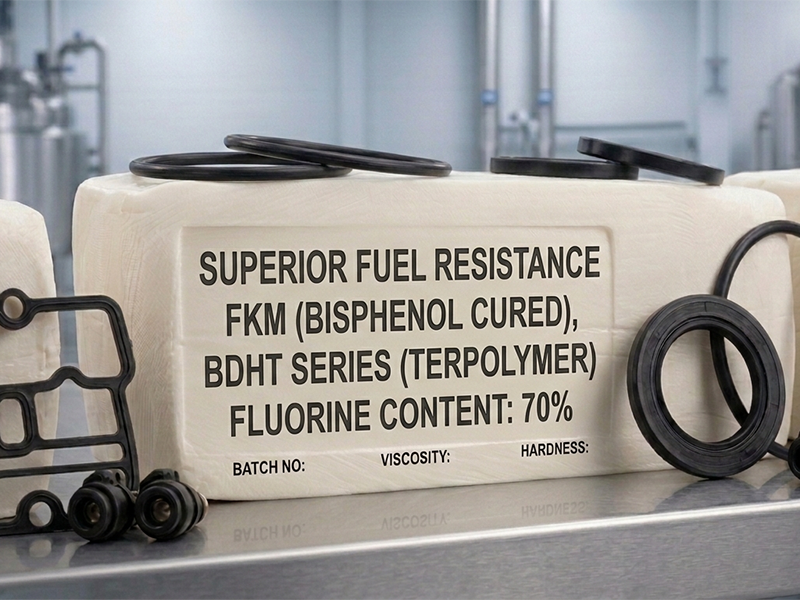
NFS-FKM is the fluoroelastomers manufactured with non-fluorinated surfactant instead of the conventional fluorinated surfactant as the polymerization aid, serving as one of the core upgrading directions of the fluoroelastomer industry amid tightening global PFAS regulations. The fluorinated surfactant for FKM polymerization are mostly short-chain PFAS substances, and the their potential environmental risks in polymer manufacturing, subsequent application, emission and residue are drawing more and more attentions in global FKM industrial chain. With the continuous tightening of PFAS regulatory trends and scope, some FKM manufacturers, downstream users and application fields such as automotive, semiconductors, renewable energy industry and high-end industrial seals etc. are accelerating the transition to NFS-FKM for less short-chain PFAS emission, residues containment and intensified compliance.
The technical challenges with NFS-FKM lie primarily in the polymerization system reconstruction, stable mass production and comprehensive performances balance of the polymer. Traditional FKM emulsion polymerization relies on the excellent compatibility between fluorinated surfactant and fluorinated monomers, which can stabilize the polymerization system, ensure stable reaction rate, uniform polymer molecular weight distribution, low gel impurity content, with a wide process controllable window and high mass production stability.After replacing with NFS as the polymerization aid , the interfacial affinity between aids and fluorinated monomers is greatly reduced, and the emulsion dispersion stability is significantly weakened, which is prone to problems such as monomer coalescence and polymerization conversion rate fluctuation. This directly leads to wider polymer molecular weight distribution and increased gel content, correspondingly the risks of compromising rheological and mechanical properties such as compression set and swelling resistance ,compared with the typical fluorosurfactant-based FKM.
With the continuous iteration and maturation of NFS-FKM manufacturing technology, certain types of NFS-FKM have achieved rheological, mechanical, thermal and fluid resistance properties close or equivalent to those of conventional FS-based products. In addition, by eliminating traditional fluorinated surfactant, NFS-FKM technology significantly reduce the risks of residual and emission of fluorinated surfactant in the full chain of fluoroelastomer industry from the source of polymer manufacturing. As the fluoroelastomer industry actively responds to the global regulatory trend of risk PFAS restriction, and commits to green production and sustainable development, NFS-FKM are providing more diversified eco-friendly options for the industry.